
History-Periods
Past eras

From pre-history to today
Choose your period

Pre history - Present
explore the different eras
Past eras
Choose your period
explore the different eras
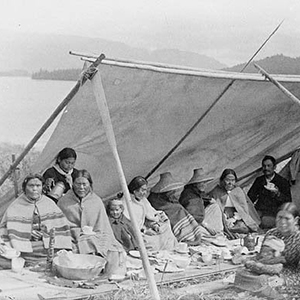
The Tsimshian people are believed to have originated from Asia, as part of the larger migration of indigenous peoples from Asia to North America over thousands of years. The exact origin and timeline of this migration is not well documented, but evidence suggests that the Tsimshian people have been living in the Pacific Northwest Coast for thousands of years.
The Tsimshian people are indigenous to the Pacific Northwest Coast of North America, primarily in British Columbia, Canada. They have a rich cultural heritage and a long history that dates back thousands of years. The origin of the Tsimshian people is not well documented, but they are believed to have thrived in the area now known as the Skeena River in British Columbia.
The Tsimshian people had limited contact with Europeans in the late 18th and early 19th centuries, when European explorers and fur traders began to arrive in the Pacific Northwest Coast of North America. The first recorded contact between the Tsimshian and Europeans was in 1787, when the British fur trader Charles Duncan visited the area. In the following decades, the Tsimshian people experienced increased contact with Europeans, which had significant impacts on their culture, economy, and way of life.
The Tsimshian people had complex relationships with other indigenous peoples in the Pacific Northwest Coast of North America. They maintained trade and cultural relationships with neighboring indigenous groups, such as the Haida, Tlingit, and Kwakwaka'wakw. At times, they also engaged in conflict with neighboring groups over resources, territory, or inter-tribal disputes. The relationships between the Tsimshian and other indigenous peoples were influenced by a variety of factors, including geography, resources, trade networks, and cultural practices.
The Tsimshian people engaged in conflicts with other indigenous peoples in the Pacific Northwest Coast of North America. These conflicts were typically over resources, territory, or inter-tribal disputes, and were resolved through various means, including war, negotiation, or diplomacy. The exact nature and frequency of these conflicts varied over time and between different indigenous groups. However, it is generally recognized that inter-tribal conflict was a common feature of life in the Pacific Northwest Coast prior to European contact.
the Tsimshian people, like many indigenous peoples in the Pacific Northwest Coast of North America, had a form of slavery prior to European contact. Slaves were acquired through warfare, kidnapping, or trade with other indigenous groups and were used for labor, prestige, or to resolve debts. The practice of slavery was abolished in the late 19th century following the arrival of European settlers and the imposition of colonial laws.
The impact of European contact on the Tsimshian people was significant and far-reaching. European contact brought new diseases, technologies, and trade goods to the region, which had significant impacts on the Tsimshian culture, economy, and way of life.
In the early years of contact, the Tsimshian people saw an increase in trade with Europeans, which brought new wealth and resources to the region. However, this was also accompanied by increased competition with other indigenous groups and the exploitation of natural resources by European settlers.
In the 19th and 20th centuries, the Tsimshian people experienced significant disruption and loss as a result of European colonization and the imposition of government policies aimed at assimilating indigenous peoples into dominant culture. This included the loss of land, the suppression of cultural practices, and the forced removal of children from their families to attend residential schools.
The Tsimshian people relied on a variety of sources for their food and material needs, including fishing, hunting, gathering, and agriculture. They lived in a rich and diverse ecosystem along the Pacific Northwest Coast of North America, which provided a range of resources to support their communities.
The Tsimshian people were skilled fishermen and relied heavily on salmon, halibut, and other seafood as a source of food. They also hunted and gathered a variety of animals and plants, including deer, elk, berries, and roots. Agriculture was also an important source of food, and the Tsimshian people grew crops such as potatoes and beans.
In terms of material goods, the Tsimshian people relied on the natural resources in their environment, including cedar, spruce, and other trees for the construction of homes, canoes, and other tools. They also traded with other indigenous groups for goods such as copper, which was used for jewelry, weapons, and tools. The rich cultural traditions of the Tsimshian people are reflected in the intricate carvings, weavings, and other art forms that they produced, using materials such as cedar bark, feathers, and animal hides.
The Tsimshian people traditionally spoke the Tsimshian language, also known as Sm'algyax. Tsimshian is a member of the Tsimshianic branch of the Pacific Coast Salish language family, and is related to other indigenous languages of the Pacific Northwest Coast of North America.
The Tsimshian language is rich in history, culture, and tradition, and was traditionally used for everyday communication, storytelling, and cultural practices such as potlatching and dance. It was also used in a variety of written forms, including writing on bark, hide, and other materials, and was a key part of the oral tradition of the Tsimshian people.
Today, the Tsimshian language is considered endangered, with a limited number of fluent speakers and limited opportunities for language revitalization and preservation. However, there are ongoing efforts within the Tsimshian communities to reclaim and revitalize their language, including language immersion programs and other initiatives to promote the use of the Tsimshian language in daily life.
Timeline
The Tsimshian people had a complex and rich spiritual tradition, rooted in their relationship with the natural world and their ancestors. They believed in a pantheon of supernatural beings, including animal spirits and creator beings, who had significant power and influence over their lives.
The Tsimshian people believed in an afterlife, and their spiritual beliefs were closely connected to their cultural practices, such as potlatching, dance, and storytelling. They also had a rich tradition of shamanism, which involved using spiritual practices and rituals to communicate with the supernatural world and heal the sick.
The Tsimshian people's spiritual beliefs and practices were an integral part of their culture, and continue to play an important role in their lives and communities today. Despite the challenges posed by European contact and colonization, the Tsimshian people have worked to preserve and revitalize their spiritual traditions, and many of their practices and beliefs remain a vibrant part of their culture today.
The Tsimshian people had a complex and dynamic political structure that reflected the social, economic, and cultural relationships within their communities. They were organized into clans and houses, each with its own leaders, traditions, and economic interests.
Traditionally, the Tsimshian people had a hereditary form of leadership, where leadership positions were passed down through the generations within a family or house. This system of leadership was supported by a council of elders, who provided guidance and advice to the leaders and helped resolve disputes within the community.
The political structure of the Tsimshian people was shaped by their traditions of potlatching and gift-giving, which helped to maintain social order, build alliances, and distribute wealth within the community.
Today, the political structure of the Tsimshian people is largely influenced by the Indian Act and other colonial laws and policies, which have imposed a form of government on indigenous peoples in Canada. However, the Tsimshian people continue to maintain their own traditional forms of governance and decision-making, and many communities are working to reclaim their sovereignty and assert their independence from colonial structures.
British Columbiahistory.ca is a visitor supported web site. If you would like to submit an article or opinion, please visit our blog at www.blog.British Columbiahistory.ca.
Reference: Article by (Staff Historian), 2023
Tel: 1 604 833-9488
Email: info@canadahistorysociety.ca

All content and images are protected by copyright to Access History