
History-Periods
Past eras

From pre-history to today
Choose your period

Pre history - Present
explore the different eras
Past eras
Choose your period
explore the different eras
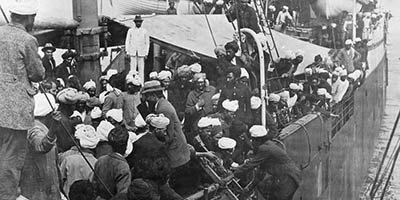
The Komagata Maru incident was a historical event that took place in 1914, where a ship named the Komagata Maru carrying 376 passengers, mostly Sikh, Muslim and Hindu immigrants from Punjab, British India, was denied entry to the port of Vancouver, Canada. The passengers were forced to return to India, where many of them were arrested and some were killed in confrontations with British colonial authorities.
The ship, Komagata Maru, arrived in Vancouver as part of a challenge to Canadian immigration policies that aimed to restrict the entry of South Asian immigrants. The passengers on the ship were primarily Sikh, Muslim and Hindu immigrants from Punjab, British India, who were seeking to start a new life in Canada. The ship's arrival was a test case for the Canadian government's recently enacted continuous journey regulation, which required immigrants to arrive in Canada directly from their country of origin, effectively excluding immigrants from India, who had to make a stop in Japan or another country en route. The passengers of the Komagata Maru hoped to challenge this regulation and gain entry to Canada. However, their efforts were unsuccessful, and the ship was forced to return to India.
Canadian immigration policies in the late 19th and early 20th centuries were restrictive towards certain groups, including South Asian immigrants, due to prevailing attitudes of racism and xenophobia. The Canadian government and many white Canadians believed that these immigrants, who were primarily Sikh, Hindu and Muslim, would not assimilate into Canadian society and would pose a threat to the country's social and economic well-being. Additionally, anti-Asian sentiment was high in British Columbia, where the majority of South Asian immigrants intended to settle, and many white residents opposed their arrival.
To limit immigration from Asia, the Canadian government introduced regulations such as the continuous journey regulation and the head tax, which made it difficult for South Asian immigrants to enter the country. These policies reflected the broader trend of nativism and exclusion that was taking place in many Western countries at the time. The restrictions on South Asian immigration remained in place for several decades and were not fully lifted until the late 1960s.
When the Komagata Maru arrived in Vancouver in 1914, the passengers were met with resistance from the Canadian government and the local community. The Canadian authorities had been alerted to the ship's arrival in advance, and immigration officials were instructed to find a way to prevent the passengers from disembarking. The passengers were informed that they were in violation of the continuous journey regulation, which required immigrants to arrive in Canada directly from their country of origin, and that they would not be allowed to land.
The passengers, who were from Punjab, British India, were forced to remain on the ship for two months, while the Canadian government and the courts deliberated on their case. During this time, they faced difficult conditions, including limited food and water supplies, and were subjected to harassment and intimidation by both the authorities and the local community.
Ultimately, the passengers were denied entry to Canada and forced to return to India, where many of them were arrested and some were killed in confrontations with British colonial authorities. The Komagata Maru incident is considered a dark chapter in Canadian history, as it highlights the discriminatory immigration policies of the time and the xenophobia and racism that were directed towards South Asian immigrants.
The incident is significant as it highlights the discriminatory immigration policies of the time and is considered a dark chapter in Canadian history.
Timeline
The Komagata Maru incident had a significant impact on the people of British Columbia, Canada, where the majority of South Asian immigrants intended to settle. At the time, anti-Asian sentiment was high in the province, and many white residents opposed the arrival of South Asian immigrants, who were seen as a threat to the social and economic well-being of the community.
The incident further fueled these negative attitudes, as the Canadian government's handling of the situation and its decision to deny entry to the passengers of the Komagata Maru was seen as discriminatory and unjust by many people in British Columbia and beyond. The incident also heightened tensions between the South Asian community and the broader Canadian society, and contributed to the ongoing marginalization of South Asian Canadians.
However, the Komagata Maru incident also inspired a sense of solidarity among South Asian Canadians, who saw it as a rallying point in their struggle for equal rights and recognition. The incident continues to be remembered and commemorated by the South Asian community and is considered an important part of Canadian history and heritage.
British Columbiahistory.ca is a visitor supported web site. If you would like to submit an article or opinion, please visit our blog at www.blog.British Columbiahistory.ca.
Reference: Article by (Staff Historian), 2023
Tel: 1 604 833-9488
Email: info@canadahistorysociety.ca

All content and images are protected by copyright to Access History