
History-Periods
Past eras

From pre-history to today
Choose your period

Pre history - Present
explore the different eras
Past eras
Choose your period
explore the different eras
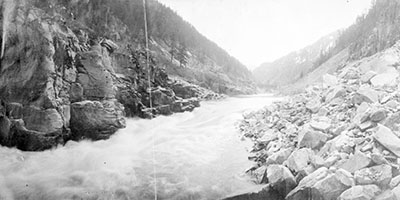
The 1914 Hell's Gate landslide in British Columbia, Canada was a catastrophic event that occurred on April 14, 1914. The landslide, caused by rapid melting of snow and heavy rain, resulted in the complete blockage of the Fraser River and caused widespread flooding in the region. The landslide caused an estimated $10 million in damage (equivalent to over $250 million today), and resulted in the deaths of at least 4 people.
Hell's Gate was named for its tumultuous and dangerous appearance. The name was given by the first European explorers who encountered the narrow gorge along the Fraser River, which was surrounded by towering cliffs and characterized by powerful currents and boiling rapids. The conditions at Hell's Gate were so treacherous that they reminded the explorers of the gates of hell, and they named the site accordingly. The name has since become synonymous with the dangerous and awe-inspiring natural beauty of the area.
Hell's Gate is located in the Fraser Canyon region of British Columbia, Canada. The site is a narrow gorge along the Fraser River, which is surrounded by towering cliffs and home to a unique geothermal area. Hell's Gate is a popular tourist destination and is known for its spectacular scenery and geological formations. The name Hell's Gate was given to the site by the first European explorers who were struck by the rugged beauty and powerful currents of the Fraser River as it passed through the narrow canyon.
The Hell's Gate landslide of 1914 in British Columbia, Canada was caused by a combination of factors. The primary cause was the rapid melting of snow and heavy rain, which saturated the ground and weakened the stability of the slopes along the Fraser River. The heavy rainfall also increased the flow of the river, adding to the stress on the slopes. The specific trigger for the landslide is not known, but it is believed that the movement of water in the soil and the rapid erosion of the riverbanks were the main factors that destabilized the slopes and caused the massive rockfall. The resulting landslide completely blocked the Fraser River, causing widespread flooding and damage downstream.
The 1914 Hell's Gate landslide did have an impact on salmon migration and spawning. The landslide completely blocked the Fraser River, altering the flow and making it difficult for salmon to migrate upstream to their spawning grounds. The blockage of the river also impacted the local fishing industry, which relied on the abundant salmon populations in the Fraser River. The fishing industry was disrupted for several years while the river channel was cleared and the flow was restored. Despite the challenges, the salmon populations eventually rebounded and the fishing industry resumed normal operations. However, the landslide remains a vivid reminder of the potential impact that natural disasters can have on local ecosystems and resource-based economies.
It remains one of the largest and most destructive landslides in Canadian history and a reminder of the power of natural disasters. The 1914 Hell's Gate landslide in British Columbia, Canada blocked the migration of several species of salmon that were returning to the Fraser River to spawn, including sockeye salmon, chinook salmon, and coho salmon. The exact reduction in numbers of these species is not known, but it is likely that the impact was significant due to the complete blockage of the river and the altered flow.
The blockage to salmon migration caused by the 1914 Hell's Gate landslide in British Columbia, Canada was eventually overcome through a combination of human intervention and natural processes. The first step was to clear the channel of the Fraser River, which was done through a combination of manual labor and dynamite. Teams of workers labored for several years to remove the debris from the landslide and restore the flow of the river.
In addition to the physical removal of the blockage, the salmon populations were also assisted through the use of fish ladders and other mechanisms. Fish ladders are designed to help salmon overcome barriers, such as dams and waterfalls, in order to reach their spawning grounds. The use of fish ladders allowed the salmon to bypass the blockage caused by the landslide and resume their migration upstream to spawn.
Overall, the efforts to overcome the blockage to salmon migration were successful, and the salmon populations in the Fraser River eventually rebounded. The experience also highlights the importance of human intervention in restoring damaged ecosystems and protecting endangered species.
Timeline
The 1914 Hell's Gate landslide in British Columbia, Canada had a significant impact on the people and environment of the area. The landslide resulted in the complete blockage of the Fraser River, causing widespread flooding and damage downstream. The flooded area included several towns and communities, which were evacuated and suffered significant damage. At least 4 people were confirmed dead as a result of the landslide and the flooding, and the total economic impact was estimated at $10 million (equivalent to over $250 million today).
In terms of the environment, the landslide altered the landscape and changed the flow of the Fraser River, which had a lasting impact on the surrounding ecosystem. The landslide also created new habitats for wildlife, as well as new opportunities for recreation and tourism. However, it also had negative impacts on the local fishing industry and other resource-based economies, as the river was blocked and the flow was altered.
Overall, the 1914 Hell's Gate landslide was a significant event in the history of British Columbia and serves as a reminder of the potential dangers posed by natural disasters in the region.
British Columbiahistory.ca is a visitor supported web site. If you would like to submit an article or opinion, please visit our blog at www.blog.British Columbiahistory.ca.
Reference: Article by (Staff Historian), 2023
Tel: 1 604 833-9488
Email: info@canadahistorysociety.ca

All content and images are protected by copyright to Access History