
History-Periods
Past eras

From pre-history to today
Choose your period

Pre history - Present
explore the different eras
Past eras
Choose your period
explore the different eras
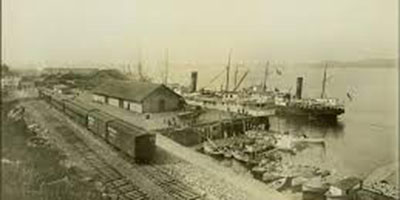
The Grand Trunk Pacific Railway (GTP) was a historical Canadian transcontinental railway that ran from Winnipeg to Prince Rupert, British Columbia. It was one of the two main branches of the Canadian National Railway, the other being the Grand Trunk Eastern Railway. The GTP was built to provide a more direct route from eastern Canada to Asia and the Pacific coast. The line from Winnipeg to Prince Rupert was completed in 1914, but the railway went bankrupt during World War I and was nationalized in 1920.
The Grand Trunk Pacific Railway (GTP) was formed on October 16, 1903. The Grand Trunk Pacific Railway (GTP) was formed by the Grand Trunk Railway Company of Canada. The company was established in order to build a second transcontinental railway in Canada and provide competition to the Canadian Pacific Railway (CPR), which had a monopoly on transcontinental rail service in Canada. The GTP was intended to serve as a more direct route from eastern Canada to Asia and the Pacific coast, and to stimulate economic growth and settlement in western Canada. The construction of the railway was supported by the Canadian government, which saw it as a way to strengthen the country's ties to Asia and the Pacific and to open up new markets for Canadian goods.
Prince Rupert, British Columbia was chosen as the terminus of the Grand Trunk Pacific Railway (GTP) because of its natural deep-water port and its proximity to Asia. The Canadian government and the Grand Trunk Railway Company believed that a Pacific coast terminus was necessary for the country to be able to compete with other nations in the trade with Asia. Prince Rupert was seen as an ideal location because of its deep, ice-free harbor, which could accommodate large ocean-going vessels, and its location near the Alaska Panhandle, which provided a shorter shipping route to Asia. The railway was built to connect Prince Rupert to eastern Canada and provide a direct link to Asia for Canadian goods.
The construction of the Grand Trunk Pacific Railway (GTP) required significant investment. The initial investment came from the Grand Trunk Railway Company and the Canadian government, which provided subsidies and land grants to support the construction of the railway. However, as construction costs escalated, additional investment was needed. This additional investment came from a number of sources, including bonds issued by the Grand Trunk Railway Company, as well as loans from banks and private investors. The government also provided additional financial support to the railway through subsidies and loans.
The building of the Grand Trunk Pacific Railway (GTP) line was a massive undertaking that took several years and involved many challenges. Some of the key events and challenges during the building of the railway include:
Financing: Securing the necessary financing to build the railway was a major challenge, as the costs of construction far exceeded initial estimates. The Grand Trunk Railway Company and the Canadian government provided initial funding, but additional investment was needed to complete the project.
Logistical challenges: Building the railway through the rugged terrain of western Canada was a major challenge. This included constructing bridges, tunnels, and trestles, as well as dealing with the harsh climate and isolation of the western wilderness.
Labour disputes: The construction of the railway involved a large and diverse workforce, which included thousands of immigrants and Indigenous people. There were several labour disputes during the construction of the railway, including strikes by workers demanding better wages and working conditions.
Competition from the Canadian Pacific Railway: The Canadian Pacific Railway (CPR) saw the Grand Trunk Pacific Railway as a threat to its monopoly on transcontinental rail service in Canada, and attempted to sabotage the construction of the GTP through lobbying and legal challenges.
World War I: The outbreak of World War I in 1914 had a significant impact on the GTP, as the war disrupted trade and reduced demand for Canadian goods. The railway went bankrupt during the war and was nationalized by the Canadian government in 1920.
Despite these challenges, the Grand Trunk Pacific Railway was completed and officially opened on April 7, 1914. It remains an important transportation corridor in western Canada to this day.
The railway was later absorbed into the Canadian National Railway system and remains an important transportation corridor in western Canada.
Timeline
The building of the Grand Trunk Pacific Railway (GTP) had a significant impact on the people of British Columbia. Some of the ways the railway affected the people of BC include:
Economic growth: The construction of the railway stimulated economic growth and development in BC by providing a direct link to eastern Canada and the rest of the world. This led to the expansion of industries such as forestry, mining, and agriculture, and created new job opportunities.
Population growth: The railway made it easier for people to travel to and settle in BC, leading to a significant increase in the province's population. This included immigrants from Europe, Asia, and other parts of Canada, as well as Indigenous people who moved to the cities for work.
Access to markets: The railway provided BC with access to markets in eastern Canada and the rest of the world, which was essential for the growth of its industries and economy.
Environmental impact: The construction of the railway had a significant impact on the environment, as large areas of forest and wildlife habitat were cleared to make way for the railway and related development. This had a lasting impact on the natural environment and the animals and plants that lived there.
Indigenous peoples: The building of the railway had a profound impact on Indigenous peoples in BC, as their traditional lands were disrupted and their way of life was changed. Many Indigenous people were displaced from their ancestral lands and forced to relocate to cities for work, leading to the loss of their cultural identity and traditional practices.
Overall, the building of the Grand Trunk Pacific Railway had both positive and negative impacts on the people of British Columbia. While it brought economic growth and development, it also had lasting environmental and cultural impacts on the province and its people.
British Columbiahistory.ca is a visitor supported web site. If you would like to submit an article or opinion, please visit our blog at www.blog.British Columbiahistory.ca.
Reference: Article by (Staff Historian), 2023
Tel: 1 604 833-9488
Email: info@canadahistorysociety.ca

All content and images are protected by copyright to Access History