
History-Periods
Past eras

From pre-history to today
Choose your period

Pre history - Present
explore the different eras
Past eras
Choose your period
explore the different eras
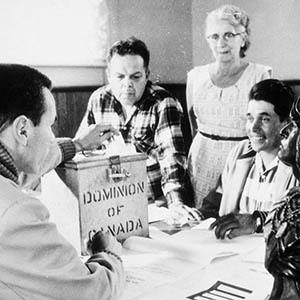
There were a number of issues that prevented Indigenous people from being able to vote in federal elections in Canada prior to 1960. One major issue was the Indian Act of 1876, which categorized Indigenous people as "wards of the state" and denied them the right to vote. Additionally, many Indigenous people were not able to meet the qualifications for voting, such as owning property or being able to read and write in English or French.
Another issue was the lack of political representation and advocacy for Indigenous rights. Indigenous people were not given the same opportunities as non-Indigenous people to participate in the political process, and their voices were often not heard or ignored.
In addition, the Indian Act of 1876 also denied Indigenous people certain rights and freedoms, including the right to vote, the right to practice their culture and traditions, and the right to own property.
There were many Indigenous leaders and activists who worked to secure the right to vote for Indigenous people in Canada. Some of the notable figures include:
Harry Daniels: He was a Cree leader and a founding member of the Indian Brotherhood of Canada (later known as the Assembly of First Nations). He was a strong advocate for Indigenous rights and worked to secure the right to vote for Indigenous people in Canada.
Bill C-31: A law passed by the Canadian government in 1985 which aimed to restore Indigenous people's rights and status. This law repealed the discriminatory provisions of the Indian Act that had previously denied Indigenous people the right to vote.
Phil Fontaine: He is a former National Chief of the Assembly of First Nations (AFN) and a prominent Indigenous rights activist. He worked to raise awareness about the issues faced by Indigenous people in Canada and advocated for their right to vote and other rights.
Mary Two-Axe Earley: She was a Mohawk woman who fought to have Indigenous women's rights recognized under the Indian Act. She advocated for Indigenous women to be able to vote and retain their Indian status, which they previously lost when they married non-Indigenous men.
In 1960, when Indigenous people in Canada were granted the right to vote in federal elections, the Prime Minister of Canada was John Diefenbaker, who was the leader of the Progressive Conservative Party.
Diefenbaker's government passed a bill in 1960 that removed the restriction on Indigenous people's right to vote in federal elections, which was part of the Indian Act.
In the House of Commons, the bill was presented by James Gladstone, a senator of Cree descent, who was the first Indigenous person to be appointed to the Senate of Canada. He was a strong advocate for Indigenous rights and played a key role in getting Indigenous people the vote.
It was a combination of the activism and pressure from Indigenous leaders and organizations, the efforts of Indigenous politicians such as James Gladstone and the support of Prime Minister Diefenbaker and his government that led to the passing of the bill in 1960 and the granting of the right to vote for Indigenous people in Canada.
Bill C-31, also known as the Indian Act Amendment and Replacement Act, was a law passed by the Canadian government in 1985. The bill aimed to address some of the discriminatory provisions of the Indian Act of 1876, which had denied Indigenous people certain rights and freedoms, including the right to vote.
The bill repealed several sections of the Indian Act, including those that had previously denied Indigenous people the right to vote. It also sought to restore Indigenous people's rights and status, which had been previously lost through various discriminatory provisions of the Indian Act.
One of the main goals of Bill C-31 was to address the issue of "enfranchisement," which was the process of Indigenous people losing their Indian status and rights when they married non-Indigenous people. The bill allowed Indigenous people who had lost their status due to enfranchisement to apply to have it restored.
Another goal of the bill was to address the issue of "non-status Indians" or Indigenous people who were not recognized as Indians under the Indian Act. Bill C-31 allowed for the registration of non-status Indians as Indians under the Act.
Additionally, the bill aimed to address the issue of gender discrimination in the Indian Act. It repealed a section of the act which denied Indian status to Indigenous women who married non-Indigenous men, but not to Indigenous men who married non-Indigenous women.
Overall, Bill C-31 was an important step towards addressing some of the discriminatory provisions of the Indian Act and restoring rights to Indigenous people in Canada. However, it should be noted that the bill was not without its criticisms and it did not fully address all of the issues Indigenous people faced.
Timeline
The process of granting Indigenous people the right to vote in Canada, and the subsequent efforts to address the discriminatory provisions of the Indian Act, had a significant cultural effect on all Canadians.
Firstly, it helped to raise awareness about the issues faced by Indigenous people in Canada and the ongoing impact of discrimination on their lives. This led to a greater understanding and appreciation of Indigenous cultures and perspectives among non-Indigenous Canadians.
Secondly, the process helped to promote greater political representation and equality for Indigenous people in Canada. This helped to give Indigenous people a greater voice and influence in shaping the country's political landscape, which in turn helped to promote a more inclusive and diverse society.
Thirdly, the process contributed to the ongoing process of reconciliation between Indigenous and non-Indigenous Canadians. Reconciliation is about addressing the harm caused by the past actions of governments and society, and working to build a better future for all Canadians.
However, it should be noted that the process of granting Indigenous people the right to vote and addressing the discriminatory provisions of the Indian Act is ongoing and not without challenges. Indigenous peoples still face structural discrimination and inequalities. And, despite some progress, the cultural effect on all Canadians is still a work in progress.
Overall, the process of granting Indigenous people the right to vote and addressing the discriminatory provisions of the Indian Act has had a significant cultural effect on all Canadians, helping to promote greater understanding, representation, and reconciliation between Indigenous and non-Indigenous peoples.
British Columbiahistory.ca is a visitor supported web site. If you would like to submit an article or opinion, please visit our blog at www.blog.British Columbiahistory.ca.
Reference: Article by (Staff Historian), 2023
Tel: 1 604 833-9488
Email: info@canadahistorysociety.ca

All content and images are protected by copyright to Access History