
History-Periods
Past eras

From pre-history to today
Choose your period

Pre history - Present
explore the different eras
Past eras
Choose your period
explore the different eras
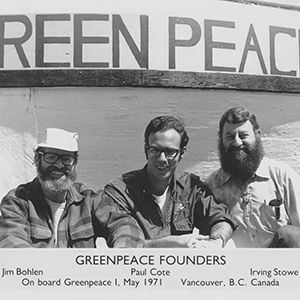
Greenpeace was started in Vancouver, Canada in 1971 by Irving Stowe and Dorothy Stowe, Ben Metcalfe, Marie Bohlen, Jim Bohlen, Paul Cote, Bob Hunter, Paul Spong, and Bob Cummings.
Greenpeace was founded in 1971 to protest US government testing of nuclear weapons in Alaska's Amchitka Island, and to promote peace, protect the environment, and promote sustainability. The organization has since expanded its focus to address a wide range of environmental issues, including climate change, deforestation, overfishing, and pollution.
Greenpeace's mandate has expanded to address a wider range of environmental issues. The organization now campaigns on various global environmental problems, including climate change, deforestation, overfishing, and pollution, as well as advocating for renewable energy, sustainable agriculture, and protection of the world's oceans. Greenpeace continues to work towards creating a greener, more peaceful world through non-violent direct action, research, and advocacy.
Greenpeace was founded in Vancouver, Canada, but the organization has since expanded and now has offices and presence in many countries around the world. The headquarters of Greenpeace International is now located in Amsterdam, the Netherlands, and the organization has regional offices in various countries, including the United States, the United Kingdom, Germany, Australia, and many others. This global network allows Greenpeace to mobilize its campaigns and activism on a global scale.
In addition to their environmental campaigns, Greenpeace has initiated a number of other activities to achieve their goals. Some of these include:
Research and Investigations: Greenpeace conducts research and investigations to gather evidence and bring attention to environmental problems.
Direct Action: Greenpeace uses non-violent direct actions, such as protests, demonstrations, and acts of civil disobedience, to raise awareness and bring attention to environmental issues.
Lobbying and Advocacy: The organization engages in lobbying and advocacy efforts to influence government policies and decision-making on environmental issues.
Media Campaigns: Greenpeace uses media and communications to bring attention to environmental issues and to promote their campaigns.
Education and Outreach: The organization runs educational programs and campaigns aimed at raising awareness and encouraging individuals to take action on environmental issues.
Greenpeace has taken various actions to stop whaling and the cutting down of old growth forests:
Whaling: Greenpeace has conducted high-profile campaigns to bring attention to the issue of whaling and to stop commercial whaling. The organization has used a variety of tactics, including direct action, research, and media campaigns, to pressure governments and the International Whaling Commission to protect whales.
Old Growth Forests: Greenpeace has worked to protect old growth forests by launching campaigns aimed at stopping deforestation, promoting sustainable forestry practices, and supporting conservation efforts. The organization has used a combination of direct action, research, and advocacy to bring attention to the issue and to pressure companies and governments to protect these forests.
Today, the organization continues to carry out campaigns and activism on a wide range of environmental issues, including climate change, deforestation, overfishing, and pollution.
Greenpeace is recognized as one of the world's leading environmental organizations and has a significant global presence, with offices and activists in many countries around the world. The organization continues to use non-violent direct action, research, and advocacy to bring attention to environmental problems and to promote solutions.
Overall, Greenpeace remains a significant voice in the global environmental movement and continues to work towards creating a greener, more peaceful world.
Timeline
Greenpeace's early campaigns in British Columbia, Canada, had a significant impact on raising awareness about environmental issues among the local population and government. The organization's first campaign, which protested against a nuclear test conducted by the US government on Amchitka Island, Alaska, helped to draw attention to the issue of nuclear weapons testing in the region.
Greenpeace's campaign against commercial whaling in the 1970s and 1980s had a significant impact on the local fishing communities, which relied on the whaling industry for their livelihoods. The campaign helped to raise awareness about the impact of commercial whaling on whale populations and the environment, and ultimately led to a ban on commercial whaling by the International Whaling Commission.
Greenpeace's campaigns against pollution and deforestation in British Columbia also had a significant impact on local communities and the environment. The organization's activism helped to raise awareness about the impact of logging and industrial activities on the environment, and led to changes in government policies and corporate practices.
Throughout the years, Greenpeace has also been actively engaged in campaigns and actions that are specific to British Columbia, such as opposing the Enbridge pipeline, working to protect the Great Bear Rainforest, the campaigns against fish farming and more.
Overall, Greenpeace's early campaigns in British Columbia helped to raise awareness about environmental issues among the local population and government, and played a role in shaping policies and practices to be more environmentally friendly.
British Columbiahistory.ca is a visitor supported web site. If you would like to submit an article or opinion, please visit our blog at www.blog.British Columbiahistory.ca.
Reference: Article by (Staff Historian), 2023
Tel: 1 604 833-9488
Email: info@canadahistorysociety.ca

All content and images are protected by copyright to Access History