
History-Periods
Past eras

From pre-history to today
Choose your period

Pre history - Present
explore the different eras
Past eras
Choose your period
explore the different eras
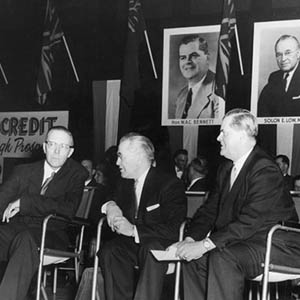
The 1952 British Columbia provincial election was held on June 12, 1952, and resulted in a landslide victory for the British Columbia Social Credit Party, led by W.A.C. Bennett. The party won 39 of the 49 seats in the Legislative Assembly.
The Social Credit Party campaigned on a platform of economic development and modernization, promising to build infrastructure projects such as hydroelectric dams and highways, and to attract industry and investment to the province. The party also promised to reduce taxes and to increase social spending.
W.A.C. Bennett became leader of the British Columbia Social Credit Party in 1951, after the previous leader, Robert Thompson, resigned. Bennett was elected as leader at the party's convention in September 1951, defeating his rivals, Ernest Roberts and George Kendall.
At the time, Bennett was not a well-known figure in British Columbia politics. He had been involved in business and had served as mayor of Kelowna, but had not held any elected office at the provincial level. However, Bennett was seen as a charismatic and dynamic leader who was able to articulate a clear and compelling vision for the party and the province.
Bennett campaigned on a platform of economic development and modernization, promising to build infrastructure projects such as hydroelectric dams and highways, and to attract industry and investment to the province. He also promised to reduce taxes and to increase social spending. His message resonated with British Columbians who were looking for a change after three decades of CCF and Liberal Party rule in the province.
In addition, Bennett was able to unite the various factions within the party and present a united front to the electorate. Under his leadership, the party was able to overcome the internal divisions that had plagued it in the past and present a coherent and cohesive platform to voters.
The party's strong performance in the 1952 election, marked the end of three decades of CCF and Liberal Party rule in British Columbia, and marked the beginning of a period of Social Credit dominance in the province under Bennett's leadership.
The Liberal/Conservative government, which had been in power since the 1941 election, faced criticism for its handling of the economy and for a number of scandals that had emerged during its time in office. Many voters were also dissatisfied with the party's policies, which were seen as out of step with the conservative leanings of many British Columbians.
The Social Credit Party's strong performance in the 1952 election marked beginning of a period of Social Credit dominance in the province.
W.A.C. Bennett became the Premier of British Columbia following the election, and led the party to consecutive majority government victories in the 1953, 1956, 1960, 1963, and 1966 elections.
The 1952 British Columbia provincial election was the first election held in the province under a preferential balloting system. Preferential balloting, also known as ranked voting or instant-runoff voting, allows voters to rank their preferred candidates in order of preference. If a candidate does not receive enough votes to win outright, the candidate with the fewest votes is eliminated, and the votes for that candidate are redistributed to the remaining candidates based on the voters' second choice. This process continues until one candidate has a majority of votes.
In the 1952 election, the preferential balloting system was seen as having a significant impact on the results. Many observers believe that the system helped the Social Credit Party to win a majority of seats, despite not receiving the most votes in a number of constituencies.
The Social Credit Party won 39 of the 49 seats in the Legislative Assembly, but only received 45% of the popular vote. The CCF government, who received 40% of the vote, only won 8 seats, while the Liberal party with 11% of the vote won 2 seats.
The preferential balloting system was seen as having helped the Social Credit Party because it allowed the party to benefit from the votes of supporters of other parties, as those supporters' second or third choices would then be redistributed to the Social Credit candidates. Some political analysts also argued that the system helped to prevent vote-splitting among the non-Social Credit parties, allowing the Social Credit party to win seats in constituencies where they might have otherwise lost.
In the following years, the preferential balloting system was criticized and eventually replaced by the first past the post system in 1952.
Timeline
The Social Credit Party was a political movement that originated in Alberta, Canada in the 1920s. The party was founded by William Aberhart, a radio evangelist, who was inspired by the economic theories of Major C.H. Douglas, a British engineer. Douglas's ideas, known as "Social Credit," proposed that governments could alleviate the problems of unemployment and poverty by creating new money and distributing it to citizens through a "national dividend" and "prices policy."
In Alberta, the Social Credit Party quickly gained support among farmers and small business owners who were suffering from the Great Depression. In 1935, the party won the Alberta provincial election in a landslide and formed the government, with Aberhart as premier. The party's success in Alberta inspired the formation of Social Credit parties in other provinces, including British Columbia.
The British Columbia Social Credit Party was formed in the early 1940s, and it was led by Robert Thompson. The party's early years were marked by internal divisions and electoral failures, but it managed to unite under W.A.C Bennett's leadership in 1951. Bennett's strong performance and charisma helped the party to win the 1952 British Columbia provincial election in a landslide and formed the government, which governed the province for 20 years.
The Social Credit Party's ideas and policies were often criticized for being populist, unrealistic and in some cases, controversial. Despite this, the party managed to maintain significant support among the electorate in the province of Alberta for many years, and have a for almost 20 years of dominance in British Columbia under Bennett's leadership.
British Columbiahistory.ca is a visitor supported web site. If you would like to submit an article or opinion, please visit our blog at www.blog.British Columbiahistory.ca.
Reference: Article by (Staff Historian), 2023
Tel: 1 604 833-9488
Email: info@canadahistorysociety.ca

All content and images are protected by copyright to Access History