
History-Periods
Past eras

From pre-history to today
Choose your period

Pre history - Present
explore the different eras
Past eras
Choose your period
explore the different eras
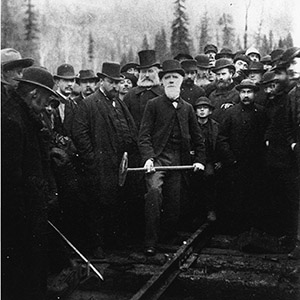
The city of Vancouver, located on the western coast of Canada near the mouth of the Fraser River and the waterways of the Strait of Georgia, Howe Sound, and Burrard Inlet, has a rich history. Its geography made it a hub for trade and settlement for thousands of years, notably by the First Nations, known as S'ólh Téméxw. European exploration began with Spanish Captain José María Narváez in 1791 and British Captain George Vancouver in 1792, but significant settlement by Europeans didn't occur until the 1860s. The completion of the Canadian Pacific Railway in the late 1880s was pivotal for Vancouver's rapid growth, as it allowed for continuous rail service from Eastern Canada. This attracted many settlers, including Chinese immigrants and Europeans moving west, and later, a diverse population from across the globe.
The early industries in the area were centered on lumbering, with the first sawmill beginning operations in 1863. The presence of large western red cedar trees was crucial for the lumber industry, which provided materials for the rapidly developing city and global markets. The area's rich ecosystem supported the Musqueam people for over 10,000 years, with abundant resources for food and materials. The local Indigenous peoples achieved a high cultural complexity, with large plank houses and social gatherings like potlatches being central to their communities.
John "Gassy Jack" Deighton played a significant role in the city's early development, establishing a saloon in 1867 that became a popular gathering spot, leading to the formation of Gastown, Vancouver's first downtown core. William Van Horne, president of the Canadian Pacific Railway, was instrumental in renaming the city to Vancouver from Granville, seeing the potential of its natural harbor as a terminus for the railway.
Vancouver's location was strategically important due to its natural harbour and access to the Pacific Ocean, which made it an ideal terminus for the transcontinental railway and a gateway for trade with Asia and Europe. This geographic advantage was further enhanced by the establishment of the Port of Vancouver, which became a significant node in global trade routes.
John Deighton, known as "Gassy Jack," was born in November 1830 in Hull, England. He grew up in a seaport, learning to sail and eventually working on American ships during the California Gold Rush. After trying his luck in gold mining during the Fraser Canyon Gold Rush and failing to strike it rich, Deighton turned to piloting steamships on the Fraser River. In 1867, after a failed business due to mismanagement in his absence, he opened the Globe Saloon on the south side of Burrard Inlet at the behest of Captain Edward Stamp, owner of Hastings Mill. His bar was constructed by sawmill workers in exchange for whisky and became the nucleus of what would later become Vancouver. Deighton's life was marked by his marriages to two Squamish women, first to a woman whose name is unknown and later to her niece, Quahail-ya, also known as Madeline Deighton.
William Cornelius Van Horne, born on February 3, 1843, in rural Illinois, began his railroad career at the age of 14. After various roles on the Illinois Central Railroad and as general superintendent of the Chicago and Alton Railway, he joined the Canadian Pacific Railway (CPR) in 1882. Van Horne became the CPR's vice-president in 1884, its president in 1888, and later chairman of the board. He oversaw the construction of the first Canadian transcontinental railway, completed in 1885 in under half the projected time. Van Horne was instrumental in expanding the CPR's operations, including initiating the sea transport division with service between Vancouver and Hong Kong and leading the company into the luxury hotel business. His vision and leadership significantly influenced the growth and development of Vancouver.
Timeline
Vancouver, British Columbia, was chosen as the western terminus of the Canadian Pacific Railway (CPR) for several reasons:
Strategic Location: Vancouver is located on the Pacific coast, making it a strategic location for trade with Asia and the Pacific Rim countries. The CPR was intended to connect Canada with these markets, so having the western terminus in Vancouver was seen as a logical choice.
Natural Harbor: Vancouver has a large natural harbor that could accommodate the shipping and transportation of goods to and from Asia. This made it an ideal location for the western terminus of the CPR.
Political Considerations: The British Columbia government offered incentives to the CPR, including land grants and subsidies, to encourage the company to choose Vancouver as the western terminus.
Growing Population: Vancouver was a rapidly growing city in the late 19th century, with a growing population and a thriving economy. This made it an attractive location for the western terminus of the CPR.
In conclusion, the choice of Vancouver as the western terminus of the CPR was driven by a combination of strategic, economic, political, and demographic considerations. The city's location on the Pacific coast, its natural harbor, favorable political conditions, and growing population all made it an attractive choice for the CPR.
British Columbiahistory.ca is a visitor supported web site. If you would like to submit an article or opinion, please visit our blog at www.blog.British Columbiahistory.ca.
Reference: Article by (Staff Historian), 2023
Tel: 1 604 833-9488
Email: info@canadahistorysociety.ca

All content and images are protected by copyright to Access History