
History-Periods
Past eras

From pre-history to today
Choose your period

Pre history - Present
explore the different eras
Past eras
Choose your period
explore the different eras
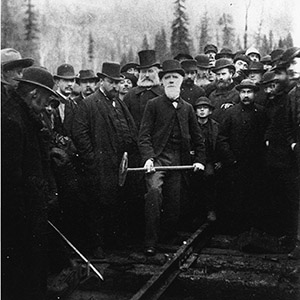
The "Last Spike" refers to the final spike driven into the Canadian Pacific Railway (CPR) line, completed in 1885. This event marked the completion of the first transcontinental railway in Canada and connected the country from coast to coast. The driving of the "Last Spike" was a significant moment in Canadian history, symbolizing the country's unity and the opening of the West for settlement and development.
In the late 19th century, the Canadian Pacific Railway (CPR) was built to connect Eastern Canada with British Columbia on the Pacific coast. The building of the railway was a massive project that involved overcoming many obstacles, including rugged terrain, harsh weather conditions, and financial challenges. Despite these difficulties, the CPR was completed in 1885, connecting the east and west coasts of Canada for the first time. The building of the CPR had a significant impact on the economic and political development of the country, facilitating the growth of trade and industry, and helping to unite the diverse regions of Canada.
The Canadian Pacific Railway faced a major challenge in building a railway through the Rocky Mountains in British Columbia. The company surveyed several potential routes through the mountains, ultimately choosing two: the Yellowhead Pass and the Kicking Horse Pass.
The Yellowhead Pass, located in central British Columbia, was chosen as the main route for the CPR, as it offered a relatively easy grade and a relatively direct route. The Kicking Horse Pass, located in the southern part of the province, was chosen as an alternate route because it offered a more direct route between the east and west coasts of Canada.
The building of the railway through the Rocky Mountains was a significant engineering feat, requiring the construction of bridges, tunnels, and switchbacks to navigate the steep and rugged terrain. Despite these difficulties, the CPR was completed in 1885, providing a vital link between the east and west coasts of Canada.
The building of the Canadian Pacific Railway (CPR) involved a large and diverse workforce, including immigrants from all over the world, as well as Indigenous peoples and local residents.
Many of the workers who built the CPR were immigrants from countries such as China, Ireland, Scotland, and Eastern Europe. These workers faced significant challenges, including harsh working conditions, low wages, and discrimination. Despite these difficulties, they remained dedicated to the project and played a crucial role in its completion.
Indigenous peoples also played a role in building the CPR. Some worked as laborers, while others provided supplies and support services to the construction crews. In addition to immigrants and Indigenous peoples, local residents and settlers also played a role in building the CPR. They provided supplies and support services, and some worked as laborers or as engineers and surveyors.
Overall, the building of the CPR was a massive effort that required the contributions of many people from diverse backgrounds. Despite the challenges they faced, they remained committed to the project and worked together to overcome obstacles and complete the railway.
The last spike of the Canadian Pacific Railway was driven by Donald A. Smith, a prominent Canadian businessman and politician. Many dignitaries and politicians were present at the driving of the last spike of the Canadian Pacific Railway in 1885, including George Stephen, the first president of the CPR, and James J. Hill, an American railroad magnate.
The Canadian Pacific Railway (CPR) was built in the late 19th century primarily to connect the far-flung regions of Canada and facilitate the transportation of goods and people across the country. The CPR was also seen as a way to assert Canadian sovereignty, promote westward expansion and settlement, and increase trade and commerce. Additionally, the building of the railway was seen as a means of unifying the country and overcoming the challenges posed by its vast size and challenging geography.
The Canadian Pacific Railway (CPR) was of great importance to British Columbia (BC) for several reasons. Firstly, it allowed for the connection of BC to the rest of Canada and facilitated the transportation of goods and people across the country. This led to increased trade, commerce, and settlement in BC, helping to spur its economic growth. Secondly, the building of the CPR was a key factor in BC's decision to join Confederation in 1871. The promise of a transcontinental railway connecting BC to the rest of Canada was a major factor in the province's decision to become part of the country. Finally, the CPR also played an important role in the development of BC's natural resources, including the mining of coal, gold and other minerals, and the logging of its vast forests.
Timeline
Vancouver, British Columbia, was chosen as the western terminus of the Canadian Pacific Railway (CPR) for several reasons:
Strategic Location: Vancouver is located on the Pacific coast, making it a strategic location for trade with Asia and the Pacific Rim countries. The CPR was intended to connect Canada with these markets, so having the western terminus in Vancouver was seen as a logical choice.
Natural Harbor: Vancouver has a large natural harbor that could accommodate the shipping and transportation of goods to and from Asia. This made it an ideal location for the western terminus of the CPR.
Political Considerations: The British Columbia government offered incentives to the CPR, including land grants and subsidies, to encourage the company to choose Vancouver as the western terminus.
Growing Population: Vancouver was a rapidly growing city in the late 19th century, with a growing population and a thriving economy. This made it an attractive location for the western terminus of the CPR.
In conclusion, the choice of Vancouver as the western terminus of the CPR was driven by a combination of strategic, economic, political, and demographic considerations. The city's location on the Pacific coast, its natural harbor, favorable political conditions, and growing population all made it an attractive choice for the CPR.
British Columbiahistory.ca is a visitor supported web site. If you would like to submit an article or opinion, please visit our blog at www.blog.British Columbiahistory.ca.
Reference: Article by (Staff Historian), 2023
Tel: 1 604 833-9488
Email: info@canadahistorysociety.ca

All content and images are protected by copyright to Access History