
History-Periods
Past eras

From pre-history to today
Choose your period

Pre history - Present
explore the different eras
Past eras
Choose your period
explore the different eras
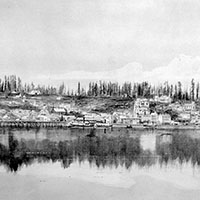
New Westminster was chosen by Colonel Richard Clement Moody, the first Lieutenant Governor of the Colony of British Columbia as the capital for the colony. He was the one responsible for the survey and selection of the site, and he named it "Queensborough" in honor of Queen Victoria. He also designed the street layout and oversaw the construction of the city's first public buildings, including the Royal Engineers' barracks.
The name of the city was officially changed from Queensborough to New Westminster in honor of the British monarchy and the city of Westminster, London, England, which was the seat of the British government at the time.
Colonel Richard Clement Moody, the first Lieutenant Governor of the Colony of British Columbia, chose the site of New Westminster (then named "Queensborough") over Fort Langley as the capital of the colony for several reasons.
First, Fort Langley was located upstream on the Fraser River, and the river was not easily navigable at that point, which would have made it difficult to transport goods and people to and from the capital.
Second, the site of New Westminster offered a more favorable location for a transportation hub, as it was located at the head of navigation on the Fraser River, which was the main transportation route for goods and people in the region.
Third, the location of New Westminster provided access to the coast, which was important for trade and communication with other British colonies and with the United Kingdom.
Finally, the location of New Westminster offered natural resources like timber, fish, and minerals that could be exploited to support the colony's economy.
All these factors made New Westminster a more favorable location for the capital of the colony than Fort Langley, and led Colonel Richard Clement Moody to establish the city there.
There was a defensive reason for choosing the site of New Westminster (then named "Queensborough") as the capital of the colony of British Columbia. The location at the confluence of the Fraser and Pitt Rivers provided a natural defense against potential attacks. The rivers served as a barrier that would have made it difficult for enemy ships to navigate and attack the city. Additionally, the location of the city on a hill above the river provided a tactical advantage, allowing the defenders to have a clear view of approaching ships and potential invaders.
Furthermore, Colonel Richard Clement Moody, the first Lieutenant Governor of the Colony of British Columbia, was a Royal Engineer, and his background and experience in military engineering was an important factor in his decision to establish the city at that location. He designed the street layout and oversaw the construction of the city's first public buildings, including the Royal Engineers' barracks, which were intended to house troops and provide protection for the city.
In summary, the location of New Westminster at the confluence of the two rivers provided a natural defense against potential attacks and was an important consideration in the decision to establish the city as the capital of the colony of British Columbia.
The city was named after New Westminster, London, England, in recognition of Queen Victoria, who was the British monarch at the time. The city was chosen as the capital because of its strategic location at the confluence of the Fraser and the Pitt Rivers, which made it an important transportation hub for the region.
There were soldiers and government officials who settled in New Westminster when it was established as the capital of the colony of British Columbia in 1859. The city was established by the Royal Engineers, a corps of the British Army, who were responsible for the design and construction of the city's infrastructure, including the street layout and the first public buildings. The Royal Engineers were led by Colonel Richard Clement Moody, who was also the first Lieutenant Governor of the colony.
Many of the early settlers were government officials, including colonial administrators, magistrates, and other officials who were responsible for the administration of the colony. They were responsible for the implementation of British law and governance in the colony and for the protection of the colony's citizens and interests.
In addition, there were a number of military personnel, including soldiers, stationed in New Westminster to provide security and protection for the colony. They were housed in the Royal Engineers' barracks, which were built to accommodate the troops.
In summary, when New Westminster was established as the capital of the colony of British Columbia, it was established by the Royal Engineers, a corps of the British Army, and many of the early settlers were government officials and military personnel. These people played an important role in the establishment and development of the city and in the administration of the colony.
Timeline
The area which was chosen for New Westminster was already occupied by Indigenous peoples, primarily of the Coast Salish nations, including the Kwantlen, Kwikwetlem, Matsqui, Qayqayt, Semiahmoo, and Tsawwassen First Nations. These nations had lived in the area for thousands of years, and had developed complex cultures, societies, and economies based on fishing, hunting, and trading. The arrival of Europeans, especially with the gold rush of 1858, brought significant changes to the lives of Indigenous peoples in the region. The influx of settlers and the resulting development of towns and cities led to the loss of traditional territories, resources, and ways of life for many Indigenous communities. When the city of New Westminster was established, it was intended to be a British colony, and the majority of the population was white settlers, mainly of British origin. The society was mainly composed of colonial officials, merchants, tradespeople, and working-class people. The colony's economy was based on resource extraction and trade. The relationship between the Indigenous peoples and the new settlers was complex, and often fraught with tension. Many Indigenous peoples were employed as laborers on the farms and in the mills, and in other jobs that supported the colony's economy.
British Columbiahistory.ca is a visitor supported web site. If you would like to submit an article or opinion, please visit our blog at www.blog.British Columbiahistory.ca.
Reference: Article by (Staff Historian), 2023
Tel: 1 604 833-9488
Email: info@canadahistorysociety.ca

All content and images are protected by copyright to Access History