
History-Periods
Past eras

From pre-history to today
Choose your period

Pre history - Present
explore the different eras
Past eras
Choose your period
explore the different eras
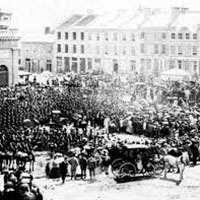
The movement toward Confederation in Canada began in the mid-1800s as the colonies of British North America sought to unite for economic and political reasons. In 1864, the Province of Canada (comprising modern-day Ontario and Quebec) and the colonies of Nova Scotia and New Brunswick came together to form the Dominion of Canada. This laid the foundation for further expansion and the eventual inclusion of other British North American colonies and territories.
The politicians behind Confederation in Canada were primarily from the Province of Canada (comprising modern-day Ontario and Quebec) and the colonies of Nova Scotia and New Brunswick. The most prominent figures in the movement were Sir John A. Macdonald, George-Étienne Cartier, and Sir George-Étienne Cartier, who were the leaders of the Conservative Party in the Province of Canada, and Sir Charles Tupper, who was a leading figure in Nova Scotia.
These politicians were trying to achieve several goals through Confederation. One of the main reasons was to create a stronger central government that could better protect and develop the colonies' economic interests, particularly in regards to trade and transportation. They also believed that a united British North America would be better able to defend itself against potential threats from the United States. Additionally, Confederation would help to resolve ongoing political and economic issues within the colonies, such as the division of power between the French-speaking and English-speaking populations in the Province of Canada.
While the British government recognized the potential benefits of a united British North America, such as increased economic development and improved defense capabilities, they were primarily focused on maintaining control over their colonies and preserving their strategic interests in North America.
The British government was also concerned about the potential loss of their North American colonies due to the growing sentiment of self-rule and independence among the colonies, as well as the potential for the colonies to be annexed by the United States.
They saw Confederation as a way to keep the colonies united and under British control, and also to reduce the costs of administering and defending the colonies.
The politicians also saw an opportunity to expand and strengthen the British Empire by creating a larger colony that could serve as a bulwark against American expansionism and as a source of resources and soldiers for the British military.
the Northwest Territories and British Columbia were looked upon as potential areas that could join Canada after Confederation. The Northwest Territories, which at the time included present-day Alberta, Saskatchewan, and parts of Manitoba, Nunavut, and the Northwest Territories, was seen as an important region for economic development and expansion. It was rich in natural resources, such as fur and timber, and had potential for agriculture and mining.
British Columbia, on the other hand, was a colony on the Pacific coast with a small population and a rapidly growing economy based on gold and silver mining. The colony had expressed interest in joining Confederation as early as 1868, but the terms of entry were a point of negotiation, particularly the construction of a transcontinental railway.
Both territories were seen as valuable additions to the newly formed Dominion of Canada and their inclusion would greatly expand Canada's territory, resources, and economic potential. The Northwest Territories and British Columbia officially joined Canada in 1870 and 1871, respectively.
The final confederation of Canada occurred on July 1, 1867, with the addition of the provinces of Quebec, Ontario, Nova Scotia, and New Brunswick.
Timeline
The formation of Canada through Confederation in 1867 had a significant cultural impact on the people of the newly formed country.
One of the main cultural impacts was the integration of the French-speaking population of Quebec with the English-speaking population of the other colonies. Confederation was seen as a way to address the political and economic tensions between the two groups and to create a more united country. However, it also led to the suppression of the French language and culture in many areas of the country, which would be a source of tension for many years to come.
Another cultural impact was the inclusion of the Indigenous peoples and the territories they inhabited within the borders of the new country. The government's policies towards Indigenous peoples were often exploitative and harmful, and their cultures and ways of life were often marginalized.
The addition of the Northwest Territories and British Columbia also brought a diverse group of new settlers and immigrants to Canada, including people from Europe, China, and the United States, which added to the already diverse population and expanded the country's cultural heritage.
Overall, Confederation brought about a new sense of national identity and unity among the inhabitants of the British North America colonies, but it also brought challenges and tensions, particularly with regards to the rights and treatment of Indigenous peoples and the French-speaking population.
British Columbiahistory.ca is a visitor supported web site. If you would like to submit an article or opinion, please visit our blog at www.blog.British Columbiahistory.ca.
Reference: Article by (Staff Historian), 2023
Tel: 1 604 833-9488
Email: info@canadahistorysociety.ca

All content and images are protected by copyright to Access History