
History-Periods
Past eras

From pre-history to today
Choose your period

Pre history - Present
explore the different eras
Past eras
Choose your period
explore the different eras
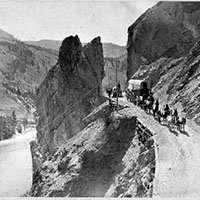
The Cariboo Wagon Road was a 600-mile long trail that ran through the British Columbia interior in Canada, connecting the gold rush town of Barkerville with the Fraser River. It was built in the early 1860s to serve the needs of the Cariboo Gold Rush, and was used by prospectors, merchants, and other travelers until the late 1800s. The road was extremely difficult to navigate, with steep grades, rocky terrain, and numerous streams and rivers to cross. Despite these challenges, it played a significant role in the development of British Columbia and the settlement of the interior of the province.
The Cariboo Wagon Road was constructed in the early 1860s to serve the needs of the Cariboo Gold Rush. The gold rush began in 1858, and thousands of prospectors, merchants, and other travelers descended on the area in search of gold. The existing trails and roads were inadequate to handle the influx of people and supplies, so the decision was made to build a new road to connect the goldfields with the Fraser River.
The road was built by a combination of government officials and private contractors. The British Columbia government hired contractors to construct the road, and also employed a large number of men to work on the road as well. Many of the men who built the road were prospectors themselves, who were looking for work during the winter months when gold mining was not possible. The construction of the road was a massive undertaking and it took several years to complete. The government also used prisoners from the New Westminster penitentiary as labor.
The Cariboo Wagon Road was one of the most important infrastructure projects in the history of British Columbia, and played a crucial role in the development of the province. It allowed for the movement of people and goods between the goldfields and the coastal cities, which facilitated the growth of the mining industry and the settlement of the interior of the province.
The Royal Engineers played a significant role in the construction of the Cariboo Wagon Road. The British Columbia government hired a detachment of Royal Engineers, which was a corps of military engineers within the British Army, to survey and plan the route for the road. They were responsible for determining the best path through the rugged terrain, and for designing and supervising the construction of the road.
The Royal Engineers were led by Captain William Downie, who was appointed as the chief engineer of the road. He and his team of engineers surveyed the route, marked out the road, and oversaw the construction of bridges, culverts and other infrastructure. They used their expertise in engineering and surveying to design the road to be as efficient and practical as possible. They also provided technical assistance and trained local workers in the construction techniques.
The Royal Engineers' work on the Cariboo Wagon Road was highly valued by the British Columbia government, and their efforts were instrumental in the successful completion of the road. They were also involved in other infrastructure projects in the province, such as the construction of the New Westminster Penitentiary, and the construction of the first telegraph line in British Columbia.
Before the construction of the Cariboo Wagon Road, the main alternatives for reaching the Cariboo goldfields were by boat up the Fraser River or by foot along existing trails. The Fraser River route was the most popular and efficient way to reach the goldfields, but it was still a difficult and dangerous journey. The river was shallow in many places, and the boats had to be portaged around rapids and waterfalls. Additionally, the river was prone to flooding and could be impassable during the spring.
Another alternative was to reach the goldfields by foot along existing trails. There were several trails that led to the Cariboo region, such as the Hudson's Bay Company's Brigade Trail and the Dewdney Trail. However, these trails were not well-maintained, and were often difficult to navigate, especially for wagons and other vehicles. They also had significant sections that were steep, rocky and not passable by wheeled vehicles.
Because of the difficulties and dangers of these routes, the construction of the Cariboo Wagon Road was seen as a necessary step in opening up the region to settlement and economic development. The road provided a safer and more efficient way to reach the goldfields, and made it possible for large numbers of people and supplies to be transported to the interior. It also opened the door to further development and expansion into the region, and was a key factor in the growth and prosperity of British Columbia.
Timeline
The Cariboo Wagon Road was primarily used by prospectors, merchants, and other travelers during the Cariboo Gold Rush. Prospectors used the road to reach the goldfields, while merchants used it to transport goods and supplies to the goldfields to sell to the prospectors. The road also served the needs of other travelers, such as miners, settlers, and government officials, who were traveling to and from the interior of the province.
The construction of the Cariboo Wagon Road provided many benefits for the general population. It made it possible for large numbers of people to reach the goldfields, which helped to fuel the growth of the mining industry and the settlement of the interior of the province. Additionally, it facilitated the movement of goods and supplies, making it easier to transport heavy equipment and other materials needed for mining and construction. This led to the growth of the mining industry, and the development of towns and cities along the road such as Barkerville, Richfield, and Clinton.
It also opened up new trade routes and economic opportunities. It allowed the prospectors and merchants to travel to the goldfields and back to the coastal cities, which facilitated the growth of the mining industry and the settlement of the interior of the province. This also allowed merchants to bring goods and supplies to the goldfields, which helped fuel the growth of the mining industry.
The Cariboo Wagon Road also played an important role in the development of British Columbia, by connecting the interior of the province with the coastal cities and opening up new opportunities for trade and economic development. Additionally, it helped to spur the development of other infrastructure projects, such as telegraph lines and the construction of new towns and cities.
British Columbiahistory.ca is a visitor supported web site. If you would like to submit an article or opinion, please visit our blog at www.blog.British Columbiahistory.ca.
Reference: Article by (Staff Historian), 2023
Tel: 1 604 833-9488
Email: info@canadahistorysociety.ca

All content and images are protected by copyright to Access History