
History-Periods
Past eras

From pre-history to today
Choose your period

Pre history - Present
explore the different eras
Past eras
Choose your period
explore the different eras
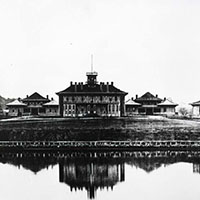
Before the current British Columbia Legislative buildings, known as the Parliament Buildings, were completed in 1897, there were several other buildings that served as the seat of government for the colony and later the province of British Columbia.
The first legislative assembly met in 1856 in a rented space in a building known as the "Colonial Building." This building was located on the corner of Yates and Langley streets in Victoria and served as the legislative chamber for the colony until 1863.
After that, the legislative assembly moved to a new building known as the "Government House," which was located on the present-day site of the Parliament Buildings. The Government House was a two-story wooden building that served as the legislative chamber and government offices until the current Parliament Buildings were completed in 1897.
The "Government House" was a two-story wooden building that served as the legislative chamber and government offices for the colony and later the province of British Columbia from 1863 until the completion of the current Parliament Buildings in 1897. It was located on the present-day site of the Parliament Buildings in Victoria. The building was designed in the Italianate style and had a central tower, a verandah, and a number of decorative elements.
During its time as the seat of government, the Government House was the site of many important events and decisions in the history of British Columbia. It was here that the colony of British Columbia was united with the colony of Vancouver Island in 1866, and it was also the site of the first meeting of the united colony's legislative assembly. The building also served as the office of the lieutenant governor and the premier, and it was the site of many official ceremonies and receptions.
However, as the population of British Columbia grew, the wooden Government House proved to be too small for the needs of the government and the legislative assembly, and plans were made for a new and larger building to be constructed on the same site.
Government House was designed by architect John Wright. He was an architect and civil engineer who had immigrated to Victoria from Scotland in 1858. He was responsible for designing many public buildings in Victoria and the surrounding area during the late 19th century, including the Government House.
It was built by contractor and carpenter William Wright, who was also from Scotland. He was responsible for the construction of many buildings in Victoria and the surrounding area during the late 19th century.
Timeline
During its time as the seat of government, the Government House in Victoria, British Columbia was the site of many important events and decisions in the history of the colony and later the province. Some of these events and legislation passed include:
1866: The colony of British Columbia is united with the colony of Vancouver Island, and the first meeting of the united colony's legislative assembly takes place in the Government House.
1871: The British Columbia government passed An Act for the Preservation of Fish and Game, which regulated hunting and fishing in the colony.
1872: The colony's first public education system was established by the government in the Government House.
1875: The colony's first railway, the Esquimalt and Nanaimo Railway, was approved and construction began.
1876: The colony's first political party, the British Columbia Conservative Party, was formed in the Government House.
1878: The government passed the Chinese Immigration Act, which imposed a head tax on Chinese immigrants.
These are just a few examples of the many events and legislation that took place in the Government House during its time as the seat of government. It was
also the site of many official ceremonies and receptions, as well as the office of the lieutenant governor and the premier.
British Columbiahistory.ca is a visitor supported web site. If you would like to submit an article or opinion, please visit our blog at www.blog.British Columbiahistory.ca.
Reference: Article by (Staff Historian), 2023
Tel: 1 604 833-9488
Email: info@canadahistorysociety.ca

All content and images are protected by copyright to Access History