
History-Periods
Past eras

From pre-history to today
Choose your period

Pre history - Present
explore the different eras
Past eras
Choose your period
explore the different eras
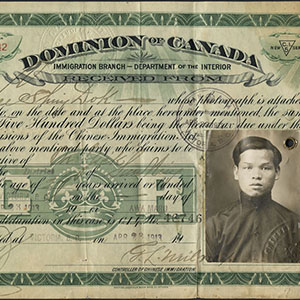
The Chinese Immigration Act of 1923, also known as the Chinese Exclusion Act, was a law passed by the Canadian government that effectively banned Chinese immigration to Canada. The law was passed as an amendment to the Immigration Act of 1910, which had already imposed a "head tax" on Chinese immigrants. The 1923 Act went even further, by completely prohibiting the immigration of Chinese persons to Canada, with very few exceptions. This law was in place until 1947, when it was repealed and Chinese immigration to Canada was once again permitted. The law was widely criticized at the time, and is now viewed as a discriminatory and racist policy. In 2006, the Canadian government formally apologized for this law and for the head tax that had been imposed on Chinese immigrants in the past.
In the 1920s, the attitude of many people in British Columbia, Canada, towards Chinese immigration was negative. There was a significant anti-Chinese sentiment in the province, which was driven by a number of factors.
One major factor was economic competition. Many white British Columbians saw the Chinese as a threat to their job security, as they were often willing to work for lower wages. This led to resentment and hostility towards the Chinese.
Another factor was racism. The Chinese were often viewed as being racially inferior, and were subject to discrimination and prejudice. This was reinforced by the media and government, which often portrayed the Chinese in a negative light.
Additionally, the Chinese were viewed as a cultural threat to British Columbia's dominant Anglo-Saxon society, which further fanned the flames of anti-Chinese sentiment.
As a result of these attitudes, Chinese immigrants faced significant challenges in British Columbia, including discrimination, violence, and restrictive legislation such as the Chinese Immigration Act of 1923, which effectively banned Chinese immigration to Canada.
Timeline
Chinese culture has had a significant impact on the province of British Columbia, Canada. Chinese immigrants have been present in British Columbia since the mid-19th century, and have contributed to the cultural, economic, and social fabric of the province.
One of the most visible ways that Chinese culture has influenced British Columbia is through food. Chinese cuisine is extremely popular in the province, and there are many Chinese restaurants and food markets throughout British Columbia.
Chinese festivals and celebrations are also an important part of the cultural landscape of British Columbia. The Chinese New Year, also known as the Lunar New Year, is celebrated with parades and festivals in many cities in the province, including Vancouver. Other Chinese festivals such as the Mid-Autumn Festival, and the Dragon Boat Festival are also celebrated.
Chinese immigrants also brought their traditional arts and crafts, such as calligraphy, painting, and paper cutting, which are celebrated and practiced by many Chinese Canadians today.
Chinese immigrants also played an important role in the development of British Columbia's economy, particularly in the areas of fishing, logging, and mining. They also contributed to the labor movement and political activism in the province. Today, Chinese Canadians are well represented in all aspects of British Columbia's society, including politics, business, education, and the arts.
In summary, Chinese culture has had a significant impact on the province of British Columbia. Despite the challenges and discrimination that Chinese immigrants faced, their culture, customs and traditions are embraced and celebrated by many British Columbians today.
British Columbiahistory.ca is a visitor supported web site. If you would like to submit an article or opinion, please visit our blog at www.blog.British Columbiahistory.ca.
Reference: Article by (Staff Historian), 2023
Tel: 1 604 833-9488
Email: info@canadahistorysociety.ca

All content and images are protected by copyright to Access History