
History-Periods
Past eras

From pre-history to today
Choose your period

Pre history - Present
explore the different eras
Past eras
Choose your period
explore the different eras
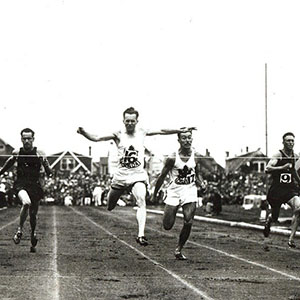
Percy Williams (1908-1982) was a Canadian sprinter from British Columbia. Born in Vancouver, he competed in the 100m and 200m events and became one of Canada's most successful Olympic athletes.
Williams rose to prominence at the 1928 Summer Olympics in Amsterdam, where he won gold medals in both the 100m and 200m races, setting a new world record in the latter with a time of 21.6 seconds. He also won a gold medal in the 4x100m relay.
Despite his Olympic success, Williams suffered from ill health throughout his life, including a bout of rheumatic fever that left him bedridden for several years. He retired from competition in 1930 and went on to become a successful businessman.
Percy Williams was inducted into the Canadian Olympic Hall of Fame in 1955 and the Canadian Sports Hall of Fame in 1956. He is remembered as one of Canada's greatest sprinters and his achievements helped establish Canada as a dominant force in international track and field.
Percy Alfred Williams was born on August 27, 1908, in Vancouver, British Columbia, Canada. He grew up in a working-class family and showed an early interest in sports, particularly track and field. Despite facing several health problems, including a bout of rheumatic fever that left him bedridden for several years, Williams worked hard to develop his athletic abilities and eventually became one of Canada's most successful Olympic athletes.
Throughout his life, Williams was known for his dedication, perseverance, and natural talent, which helped him achieve great success in track and field. He retired from competition in 1930 and went on to become a successful businessman, but his legacy as one of Canada's greatest sprinters lives on.
At the 1928 Summer Olympics in Amsterdam, Percy Williams competed in the 100m and 200m events against a field of athletes from around the world. Some of the notable competitors in these events included:
100m: Harold Abrahams (Great Britain), Arthur Porritt (New Zealand), and Donald Lippincott (USA)
200m: Samuel Ramsey (USA), Tilly Fleischer (Germany), and Antonio Campo (Italy)
Williams faced strong competition in both events, but his exceptional speed and dedication helped him secure the gold medals in both the 100m and 200m and establish himself as one of Canada's greatest sprinters.
In British Columbia, Williams' achievements were greeted with great excitement and pride. His success was seen as a reflection of the province's strong sporting culture and athletic tradition, and he was widely celebrated as a symbol of Canadian excellence and determination.
Throughout his life, Percy Williams was remembered as one of Canada's greatest sprinters and his achievements continued to inspire new generations of athletes. His legacy lives on and his victories at the 1928 Summer Olympics remain a source of pride for British Columbians and Canadians alike.
Timeline
Yes, British Columbia has produced many great athletes across a variety of sports. The province has a rich sporting culture and a strong tradition of athletic achievement, which has helped to produce many talented and successful athletes. Some notable examples of athletes from British Columbia include:
Terry Fox, a runner and cancer activist who is best known for his cross-Canada run in 1980 to raise awareness for cancer research.
Patrick Chan, a figure skater who is a three-time Olympic medallist and ten-time Canadian national champion.
Jon Montgomery, a skeleton racer who won a gold medal at the 2010 Winter Olympics in Vancouver.
Manny Malhotra, a former professional ice hockey player who had a long and successful career in the NHL.
These are just a few examples of the many talented athletes that have come from British Columbia, and the province continues to produce new generations of elite athletes in a variety of sports.
British Columbiahistory.ca is a visitor supported web site. If you would like to submit an article or opinion, please visit our blog at www.blog.British Columbiahistory.ca.
Reference: Article by (Staff Historian), 2023
Tel: 1 604 833-9488
Email: info@canadahistorysociety.ca

All content and images are protected by copyright to Access History