
History-Periods
Past eras

From pre-history to today
Choose your period

Pre history - Present
explore the different eras
Past eras
Choose your period
explore the different eras
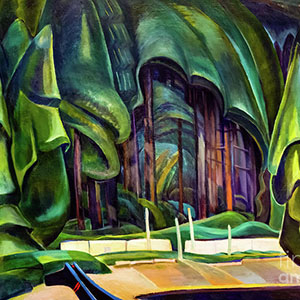
Emily Carr was a Canadian artist and writer born on December 13, 1871 in Victoria, British Columbia. She is best known for her paintings of the Pacific Northwest coast, particularly the indigenous cultures and landscapes of British Columbia. She studied art in San Francisco and London, and later travelled to remote areas of the Pacific Northwest to paint and document the indigenous cultures of the region. She was a member of the "Group of Seven," a group of Canadian artists who sought to capture the spirit of the Canadian wilderness in their art. She wrote several books, including "Klee Wyck," which won the Governor General's Award for literature, and "The Book of Small," which is a memoir of her childhood. Emily Carr died on March 2, 1945 in Victoria, British Columbia.
Emily Carr is considered one of Canada's most important painters, and is known for her contributions to the development of Canadian art and literature. Some of her most notable achievements include:
Emily Carr spent much of her life living in Victoria, British Columbia, where she was born and raised. She was heavily influenced by the Pacific Northwest coast and its indigenous cultures, particularly the Kwakwaka'wakw people of the Queen Charlotte Islands (now known as Haida Gwaii).
Carr made several trips to the Queen Charlotte Islands in the early 1900s, where she was struck by the beauty of the landscapes and the rich cultural heritage of the Kwakwaka'wakw people. She was one of the first non-indigenous people to document and paint the indigenous cultures of the region, and her paintings and writings helped to raise awareness and appreciation of the Pacific Northwest coast and its indigenous cultures.
Carr's experiences on the Queen Charlotte Islands had a profound impact on her art and writing. Her paintings of the region are known for their bold colors and strong brushstrokes, and her writings are filled with vivid descriptions of the landscapes and the cultures of the Kwakwaka'wakw people. Her work helped to shape the way Canadians viewed and understood the Pacific Northwest coast and its indigenous cultures.
Carr's time living in Victoria and her experiences on the Queen Charlotte Islands were central to her artistic and literary career, and her contributions to the documentation and preservation of the Pacific Northwest coast and its indigenous cultures continues to be celebrated today.
Timeline
Emily Carr had a significant impact on Canadian culture, particularly in the realm of art and literature.
In terms of art, her paintings of the Pacific Northwest coast and its indigenous cultures helped to define and shape Canadian art in the early 20th century. Her work was known for its bold colors and strong brushstrokes, and helped to establish a distinct Canadian style of painting. She was a member of the "Group of Seven," a group of Canadian artists who sought to capture the spirit of the Canadian wilderness in their art, and was considered one of the leading members of the group. Her works are now considered to be a national treasure and are a part of the permanent collection of several museums across the world.
In terms of literature, her books "Klee Wyck" and "The Book of Small" were well received by critics and readers alike, and helped to establish her as a prominent Canadian author. "Klee Wyck" won the Governor General's Award for literature and "The Book of Small" is considered a Canadian classic. Her writing was known for its vivid descriptions of British Columbia's landscapes and its indigenous cultures, and helped to shape the way Canadians viewed and understood their country.
In general, her work and her life helped to raise awareness and appreciation of the Pacific Northwest coast and its indigenous cultures, and helped to shape the way Canada viewed itself and its place in the world. She is widely recognized as one of Canada's most important and accomplished artists and writers and continues to be celebrated as an important figure in Canadian culture.
British Columbiahistory.ca is a visitor supported web site. If you would like to submit an article or opinion, please visit our blog at www.blog.British Columbiahistory.ca.
Reference: Article by (Staff Historian), 2023
Tel: 1 604 833-9488
Email: info@canadahistorysociety.ca

All content and images are protected by copyright to Access History