Bloody Sunday: A Pivotal Event in Canadian Labour History
Overview of the Incident
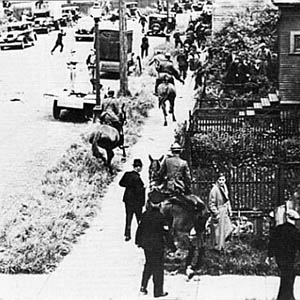
On October 14, 1935, Vancouver, British Columbia, witnessed one of the most violent confrontations in Canadian labour history, now known as "Bloody Sunday." The event unfolded as a clash between unemployed workers, who were peacefully demonstrating for government support during the harsh economic realities of the Great Depression, and police forces tasked with dispersing the crowd. Initially peaceful, the demonstration turned violent when the police attempted to break it up using batons and tear gas, resulting in several injuries among the demonstrators. Due to the level of violence and the widespread injuries, the day earned the somber nickname "Bloody Sunday." This event has since been regarded as a defining moment in Canadian labour history, offering a stark reminder of the repression faced by unemployed workers during the 1930s (McDonald, 2008).
Causes of the Bloody Sunday Incident
The roots of the Bloody Sunday clash can be traced back to the economic devastation of the Great Depression. During this period, Canada suffered unprecedented levels of unemployment, with workers struggling to find jobs or secure basic necessities. In Vancouver, a group of unemployed individuals organized a peaceful demonstration to demand government relief. Their demands included unemployment benefits and public works projects to generate jobs.
The demonstration was spearheaded by the Relief Camp Workers’ Union (RCWU), a labour organization representing unemployed men who lived in government-operated relief camps. These camps, intended to provide basic shelter and work for unemployed single men, were widely criticized for their overcrowded, unsanitary conditions and exploitative labour practices. The RCWU sought not only immediate relief but also improvements in the living and working conditions within the camps. Among their demands were fair wages for their work and significant reforms to address the inhumane conditions they endured (Patrias, 1980).
Frustrations were further fueled by the government's inadequate relief policies. Relief efforts during the Great Depression were seen as insufficient and dismissive of the broader struggles of the unemployed. This led the RCWU to escalate their activism, with Bloody Sunday representing a critical moment in their fight for justice and dignity for unemployed Canadians.
Police Response and Escalation
The police response to the peaceful demonstration is widely regarded as excessive and aggressive. Armed with batons and tear gas, officers moved to disperse the crowd when tensions rose. Their actions caused numerous injuries among the demonstrators, further inflaming the situation and drawing public condemnation. Observers at the time criticized the heavy-handed tactics, which many felt reflected the broader disdain for workers and unemployed individuals (Seager, 1993). The police response was not only a catalyst for the day’s violence but also a key factor in the public outcry that followed.
Short- and Long-Term Impacts
Short-Term Effects
In the immediate aftermath of Bloody Sunday, several demonstrators were injured, while others were arrested and charged with offences related to the clash. The incident provoked a strong reaction from the public, with many expressing outrage at the police’s approach. Reports of injuries and the use of tear gas further galvanized criticism, turning Bloody Sunday into a rallying point for the labour movement.
Long-Term Effects
The long-term impacts of Bloody Sunday were significant and far-reaching. The RCWU emerged from the incident with increased public sympathy and strengthened support from broader labour organizations. Their advocacy efforts continued, amplifying the voice of unemployed workers and pushing for systemic reforms.
The event also brought national attention to the plight of unemployed workers, raising awareness about the failures of the government’s relief efforts. In the years that followed, increased pressure from the public and labour groups prompted governments to revisit their policies, eventually leading to more robust social welfare systems in Canada.
However, the incident also had a negative effect on police-community relations. The police’s actions on Bloody Sunday left a lasting impression of authoritarianism and insensitivity, tarnishing their reputation not only in Vancouver but across Canada. Bloody Sunday remains a case study in the dangers of over-policing peaceful demonstrations, with lessons that continue to resonate in discussions about civil liberties and police accountability.
Aftermath
The Bloody Sunday incident of 1935 stands as a stark reminder of the struggles faced by workers during one of Canada’s most challenging economic periods. It highlights the courage of the unemployed in demanding justice and dignity, as well as the harsh realities of state and police opposition they encountered. Today, Bloody Sunday is studied as a key moment in Canadian labour history, reflecting both the failures of government policy during the Great Depression and the resilience of Canada’s labour movement.
References
McDonald, R. (2008). Making Vancouver: Class, Status, and Social Boundaries, 1863–1913. University of British Columbia Press.
Patrias, C. (1980). "Relief Camp Workers and the Struggle for Unionization." Labour/Le Travail, 5(1), 85-112.
Seager, A. (1993). The Working Class in Western Canada: Reflections on Economic and Social Change. Athabasca University Press.


